Types of Drilling Rigs
Different environments require fundamentally different rig designs. Water depth, geological conditions, and economics determine which type is deployed.
One Question Sorts Every Rig
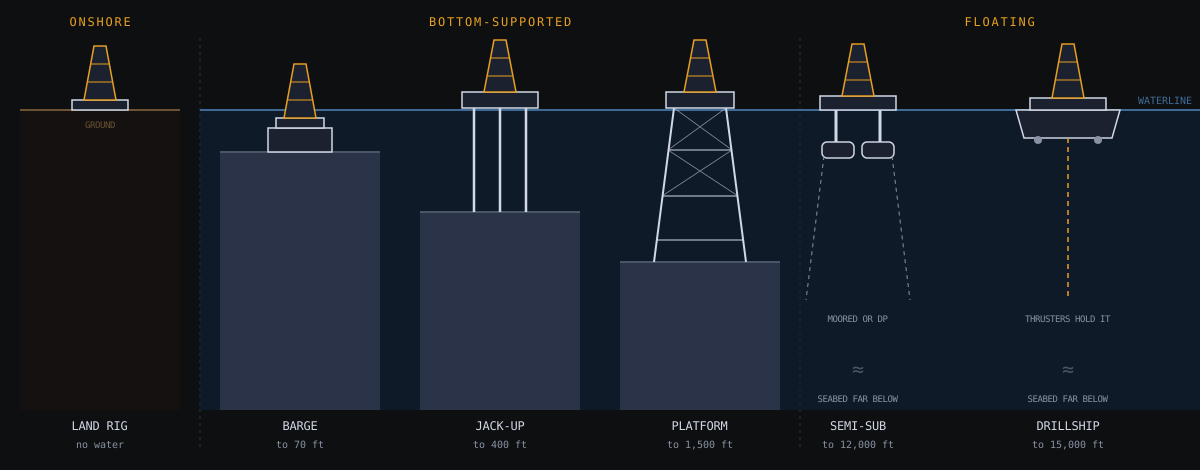
Rig types look like a list to memorise. They are not. Almost every difference between them follows from a single question: does the rig rest on the bottom, or does it float?
A rig that rests on the bottom is limited by how far down the bottom is. Legs, jackets and hulls can only reach so far, which is why bottom-supported types stop at hundreds of feet rather than thousands. A rig that floats has no such limit — but it now has to stay over the well, so its problems become station-keeping, riser length and the hydrostatic head of a mile of seawater. The water depth figures below are really measuring which of those two problems the rig was built to solve.

The Six Rig Types
Jack-up Rig
Shallow OffshoreThree or four retractable steel legs punch into the seabed, jacking the hull above wave height. The workhorse of shallow-water drilling.
Semi-submersible
DeepwaterPontoons flooded with seawater provide stability below the wave zone. Anchored or dynamically positioned. Used in deepwater plays.
Drillship
Ultra-deepwaterA purpose-built ship with a moon pool for the drill string. Dynamic positioning keeps it on location without anchors.
Platform Rig
Fixed / ProductionFixed to the seabed via steel jacket or concrete gravity base. Permanently installed, drilling dozens of wells from one location.
Submersible / Barge
Swamp / ShallowFlooded hull rests on the seabed in very shallow water — bays, swamps, and marshes. Common along the Gulf Coast and Southeast Asia.
Jack-Up vs Semi-Submersible
The two most common offshore rig types are often compared directly since they can overlap in shallower water depths.
| Jack-up Rig | Semi-Submersible | |
|---|---|---|
| Water Depth | Up to ~400 ft | 400 – 12,000 ft |
| Stability Method | Legs rest on seabed | Floats, held by anchors or DP |
| Mobility | Towed, legs must jack down/up | Can reposition more easily |
| Day Rate | Lower ($80K–$180K) | Higher ($250K–$500K) |
| Best For | Shallow shelf drilling | Deepwater exploration & development |
What Actually Decides the Rig
Rig selection is not a preference. Four constraints narrow it to one or two realistic options before anyone considers cost.
Water Depth
The hard limit. A jack-up cannot stand up in water deeper than its legs, which caps it around 400 ft. Past that the rig has to float, and a floater has to hold station instead of resting on the seabed — which changes the whole design, not just the hull.
Seabed Conditions
Jack-ups need seabed that will carry a spudcan without punch-through — a sudden leg penetration into a soft layer under a stiff crust. Site surveys exist largely to find this before the rig does. Soft or uneven seabed can rule out a jack-up in water shallow enough for one.
Weather and Station-Keeping
A moored semi-sub is good in heavy seas but slow to relocate. A dynamically positioned drillship holds position on thrusters, moves quickly between locations, and is preferred for exploration — but it depends on power and DP systems staying up.
Well Programme
One development well over a fixed platform is a different job from a multi-well exploration campaign across a licence block. Platform rigs and tender-assisted rigs exist because moving a full floating rig for routine work over an existing structure is not economic.
Land Rigs Are Not One Thing
Most rigs working worldwide are on land, and they vary as much as offshore units do. The dividing line is mobility: how fast the rig can be broken down, moved and stood back up.
Conventional rigs are dismantled into loads and rebuilt at the next location, which can take days. Mobile and telescoping-mast rigs are designed to rig down and move far faster.
Walking and skidding rigs go further: they lift and step themselves between wells on a multi-well pad without rigging down at all, which is why they dominate unconventional pad drilling where twenty-plus wells share one location.
That capability is what makes long-reach horizontal programmes economic, and it ties directly to directional drilling — the rig stays put while the wells fan out underground.
Why the mobility class matters more than the horsepower
On a pad programme, a rig that walks 40 feet to the next conductor in a shift is doing something a conventional rig would need days to do. Across twenty wells that difference is not a convenience, it is the economics of the whole pad. Rig-up and rig-down time is dead time paid at spread rate, and spread rate is the number that decides whether a well makes money.
It is also why comparing land rigs by depth rating alone is misleading. Two rigs rated to the same depth can differ by a factor of ten in how long they take to get from one well to the next.
What "Conventional" Actually Means
This is the most-confused word on the subject, because three different trades use it for three different things and none of them is wrong.
To a rig mover, a conventional rig is one that has to be dismantled into loads and rebuilt at the next location — the opposite of mobile, telescoping, walking or skidding. This is the sense used in the section above.
To a driller, conventional means the string is turned from the floor by a kelly and rotary table, rather than by a top drive hanging in the mast. That distinction is real and consequential: a top drive rotates while tripping and drills in 90-foot stands instead of 30-foot singles, which changes connection count, stuck-pipe response and how quickly the string can be reamed out of trouble.
To a geologist or a commercial team, conventional describes the reservoir, not the rig — a permeable formation that flows without stimulation, as opposed to unconventional shale that needs hydraulic fracturing. A perfectly modern walking rig with a top drive can be drilling an unconventional play, and frequently is.
The practical advice is short: when someone says conventional, establish which of the three they mean before agreeing with them. On a bid, in a scope of work, or in a handover, the three are not interchangeable and assuming the wrong one changes what you think you are getting.
Rigs That Are Not Drilling Rigs
Plenty of things on a lease get called a rig. Most of them do not drill, and the distinction matters when you are reading a job advert or a daily report.
Workover / Pulling Unit
Services wells that already exist — pulling tubing and rods, changing downhole pumps, replacing packers. Much smaller than a drilling rig, often a single truck-mounted mast, and it moves between wells in hours rather than days.
Coiled Tubing Unit
Runs one continuous reel of tubing rather than jointed pipe, so there are no connections to make. Used for clean-outs, stimulation and fishing, and it can work on a live well without killing it first.
Snubbing Unit
Forces pipe into a well that is under pressure, working against the well pushing back. Built for exactly the situation a drilling rig is not: an live, unkilled wellbore. Also the tool of last resort in some fishing operations.
Tender-Assisted Rig
A genuine drilling rig, but split in two: a compact drilling package sits on the platform while a tender vessel alongside carries the mud, power and accommodation. Used where a full platform rig would be too heavy or too expensive for the structure.
Frequently Asked Questions
What are the main types of drilling rig?
Land rigs drill onshore. Offshore, the types divide by how the rig is held in place: submersible barges, jack-ups and platform rigs rest their weight on the seabed, while semi-submersibles and drillships float and hold station on moorings or thrusters. That one distinction — bottom-supported or floating — is what sets each type’s water depth limit.
What is a conventional drilling rig?
It depends on who is speaking. To a rig mover, a conventional rig is one dismantled into loads and rebuilt at the next location, as opposed to a mobile, telescoping or walking rig. To a driller, conventional means the string is turned by a kelly and rotary table rather than a top drive. To a geologist, conventional refers to the reservoir rather than the rig. Ask which is meant before answering.
What is the difference between a jack-up and a semi-submersible?
A jack-up lowers legs to the seabed and lifts its hull above the waves, so it is a fixed structure while it works — cheaper and very stable, but limited to roughly 400 feet of water and dependent on seabed that will carry the legs. A semi-submersible floats on submerged pontoons and holds station on moorings or thrusters, which costs more but works in thousands of feet.
Which rig type works in the deepest water?
Drillships, at up to about 15,000 feet of water, with semi-submersibles close behind at around 12,000. Both are floaters, which is the reason: once a rig stops resting on the seabed, water depth stops being a structural limit and becomes a station-keeping and riser problem instead.
What decides which rig is used on a well?
Water depth rules out most options first. Seabed conditions can eliminate a jack-up even in shallow water if the ground will not carry a spudcan. Weather and station-keeping decide between moored and dynamically positioned floaters. The well programme decides the rest — one well over an existing platform is a different job from a multi-well exploration campaign.
Is a workover rig a drilling rig?
No. A workover or pulling unit services wells that already exist — pulling tubing and rods, changing downhole equipment — and is far smaller than a drilling rig. Coiled tubing and snubbing units are also well service rather than drilling, and snubbing units are built to work on a live well under pressure, which a drilling rig is not.