Differential sticking is the stuck pipe mechanism that catches people out, because nothing about the well appears to be wrong. The hole is open. Circulation is perfect. Returns are normal. The string simply will not move.
It is also the one mechanism where the instinctive response — pull harder — is close to the worst available option.
Key Takeaways
| Question | Answer |
|---|---|
| What has to be true? | Three conditions at once: overbalance, a permeable formation, and a stationary string against the wall. |
| What is the giveaway? | Circulation is completely unaffected. If you can pump normally but cannot move the string, suspect differential. |
| What makes it worse? | Time. Both the contact area and the seal improve the longer the pipe sits. |
| Why not just pull? | The force does not reduce with tension, and in deviated hole pulling can increase contact area. |
| What actually frees it? | Reducing hydrostatic pressure — which is a well control decision, not a driller’s one. |
| Where does it sit? | One of two families in stuck pipe and fishing operations. |
The Three Conditions
Differential sticking is unusual among drilling problems in having a clean, complete list of prerequisites. All three must be present simultaneously:
- Overbalance. Hydrostatic pressure meaningfully above formation pore pressure.
- A permeable formation. Typically sandstone, where fluid loss into the rock builds a filter cake against the wall.
- A stationary string in contact with that cake. The pipe has to sit still long enough for the seal to form.
Remove any one and it cannot happen. That is the practical value of the list — it tells you exactly which levers exist, both for prevention and for freeing.
How the Force Arises
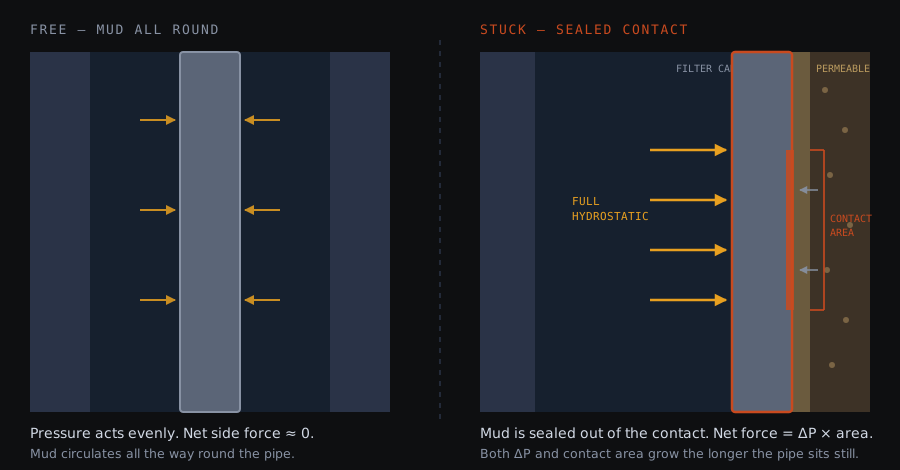
When mud can circulate all the way round the pipe, hydrostatic pressure acts on every face and the net side force is effectively zero. The pipe is free because pressure is balanced, not because pressure is low.
Let the pipe rest against the filter cake and that symmetry breaks. Mud is sealed out of the contact strip. That face is now exposed to formation pressure, while the rest of the circumference still sees full hydrostatic. The difference acts across the sealed area and presses the pipe into the wall.
The force follows directly:
F = ΔP × contact area
Both terms are hostile. ΔP is the overbalance, which is whatever the mud programme is running. Contact area starts small and grows as the pipe beds into the soft cake and the cake continues to build.
That is why time matters so much. A string recognised as stuck within a minute or two is often recoverable by working the pipe normally. The same string an hour later may need a spotting fluid and a great deal more of the day.
Why It Is Almost Always the Collars
Since force scales with contact area, sticking concentrates where the string is fattest and most likely to lie against the wall — the drill collars.
This is the reasoning behind spiral drill collars. Cutting helical grooves into the collar body removes a modest amount of weight but breaks the continuous seal along the contact strip, letting mud reach behind the contact and substantially reducing the area over which the differential can act. On wells with known differential sticking risk, that trade is usually worth making.
When It Happens
Differential sticking has a signature timing: it occurs when the string stops moving. Connections, surveys, a repair on surface, waiting on orders, a shift change that ran long.
The well drills normally. Someone makes a connection. Then the string will not come free.
That timing is diagnostic. Mechanical sticking tends to occur while something is happening — tripping through a keyseat, drilling into deteriorating hole. Differential sticking occurs during the pause.
Prevention
Each condition maps to a control.
Overbalance — carry no more than you need. Excess overbalance is the direct multiplier on sticking force. Running heavier mud than the mud weight window requires buys margin against a kick and pays for it in sticking risk. That trade should be deliberate rather than habitual.
Filter cake — keep it thin and firm. A thick, soft cake gives the pipe something to bed into, which is contact area. Fluid loss control is the mud engineer’s contribution to not getting stuck, and it is one of the clearer cases where mud properties have a direct mechanical consequence.
Movement — do not park the string on a permeable zone. Where the risk is known, connections are kept short and the string is worked rather than left hanging. Some operators specify maximum static time across known permeable intervals for exactly this reason.
Freeing It
This is where differential sticking inverts normal instincts.
Pulling harder does not address the force. Tension does not reduce ΔP or contact area. In a deviated hole it can make things worse, because pulling loads the string against the low side and can increase the contact strip. Overpull is not neutral here — it can convert a recoverable situation into a longer one.
Reducing hydrostatic pressure does address it. The force is directly proportional to overbalance, so every psi removed is a proportional reduction. That is done either by carefully reducing mud weight, or by spotting a pill of lighter fluid across the stuck interval so the reduction is local rather than well-wide.
Spotting fluids work on both terms at once. They lower local hydrostatic pressure, and many are formulated to penetrate and break down the filter cake, attacking the seal that makes the contact area effective in the first place. A spot is normally left in place and the string worked periodically rather than pulled continuously.
The reason this is emphatically not a driller’s decision on their own initiative: you are deliberately moving the well toward the bottom of the mud weight window. Reducing overbalance to free pipe increases kick risk while you do it. It is a well control decision, taken with the supervisor, with the well monitored throughout — the trade-offs are on the well control page.
Conclusion
Differential sticking is the most preventable of the stuck pipe mechanisms, because its three conditions are known in advance and at least one is usually within your control. It is also the least forgiving of delay, since the force grows continuously from the moment the string stops.
The two habits worth building: check circulation before doing anything else, because it tells you which mechanism you have; and treat a string that has stopped moving on a permeable interval as urgent rather than puzzling. The first ten minutes are worth more than the next three hours.
For how this sits alongside the mechanical mechanisms — pack-off, keyseating, wellbore instability — and what happens if freeing fails, see stuck pipe and fishing operations.
Frequently Asked Questions
What causes differential sticking?
Three conditions have to be present at once: hydrostatic pressure meaningfully above formation pore pressure, a permeable formation where a filter cake builds, and a stationary string resting against that cake. Remove any one of the three and differential sticking cannot occur.
How do you know if pipe is differentially stuck or mechanically stuck?
Circulation is the clearest test. In differential sticking the hole is open, so circulation is completely normal with unchanged pump pressure, while the string will not move in either direction. Mechanical sticking usually restricts or blocks circulation, with standpipe pressure rising, and the string is often still free in one direction.
Why does pulling harder often fail on differentially stuck pipe?
The sticking force is the pressure difference multiplied by the contact area, and it does not reduce with tension. Pulling also presses the string more firmly against the wall in a deviated hole and can increase contact area, so overpull alone frequently makes the situation worse rather than better.
Why does reducing mud weight help free differentially stuck pipe?
The sticking force is directly proportional to the overbalance, so lowering hydrostatic pressure lowers the force in proportion. This is why controlled mud weight reduction and spotting fluids are used, and why it is a well control decision, since reducing hydrostatic pressure moves the well toward kick conditions.
Why are drill collars usually the part that gets stuck?
Sticking force scales with contact area, and drill collars are the largest diameter section of the string and sit in the part most likely to lie against the wellbore wall. Spiral collars exist to reduce that contact area by cutting grooves that break the seal.
How quickly does differential sticking become serious?
It worsens continuously. The filter cake thickens and the pipe beds further into it, so both the pressure difference across the contact and the contact area grow with time. Pipe recognised as stuck within minutes is often freed by ordinary string manipulation, while the same event left for an hour may need a spotting fluid.