If you’ve spent any time on a rig floor, you’ve filled out a STOP card — or you’ve watched someone tear through a stack of them just to hit a monthly quota. That second habit is exactly why this guide exists. A pile of vague, quota-driven cards tells you a lot about whether a rig’s safety culture is real or paperwork theater, and the difference comes down to how cards are written, reviewed, and acted on.
Key Takeaways
| Question | Answer |
|---|---|
| What is a STOP card? | A behavior-based observation tool — not an incident report. It captures safe and at-risk acts before they become recordable events. |
| What makes a card useful? | Specificity. “Unsafe lifting” is useless. “Roughneck lifted 45 lb valve without team lift, back not braced” is actionable. |
| When should a card be written? | On-site, same shift. Observations logged same-shift catch patterns before the next crew change; delayed cards lose corrective value. |
| Where do STOP programs die? | The review cycle. Cards that sit unreviewed train crews to stop filling them out. |
| How does near-miss reporting survive? | Without blame. If the first card someone files gets used against them in a performance review, reporting stops. |
| What does STOP data feed into? | Equipment and procedure decisions covered on the rig safety hub, from PPE compliance to lockout/tagout gaps. |
| Where do I check observation terminology? | The field glossary — consistent terms like “LOTO” and “dropped object” keep cards comparable between observers. |
What Is a STOP Card System and Why It Exists on the Rig Floor
STOP stands for Safety Training Observation Program. DuPont originally developed the methodology, and drilling contractors adapted it for rig-specific hazards decades ago.
The core idea is simple. Most incidents don’t happen because equipment fails randomly — they happen because someone made an at-risk decision, and that decision usually had precursors a trained observer could have caught.
A STOP card is a short, structured form any crew member fills out after watching a task, whether that task was performed safely or not. It’s not an incident report. It’s a proactive behavior audit that happens before something goes wrong, which is the entire point.
Contrast this with a Job Safety Analysis or a permit-to-work document, both of which are planning tools completed before a task starts. A STOP card is completed during or immediately after observing someone else work, and it’s meant to be filled out constantly, not just after a close call.
How the STOP Card System Works: From Observation to Corrective Action
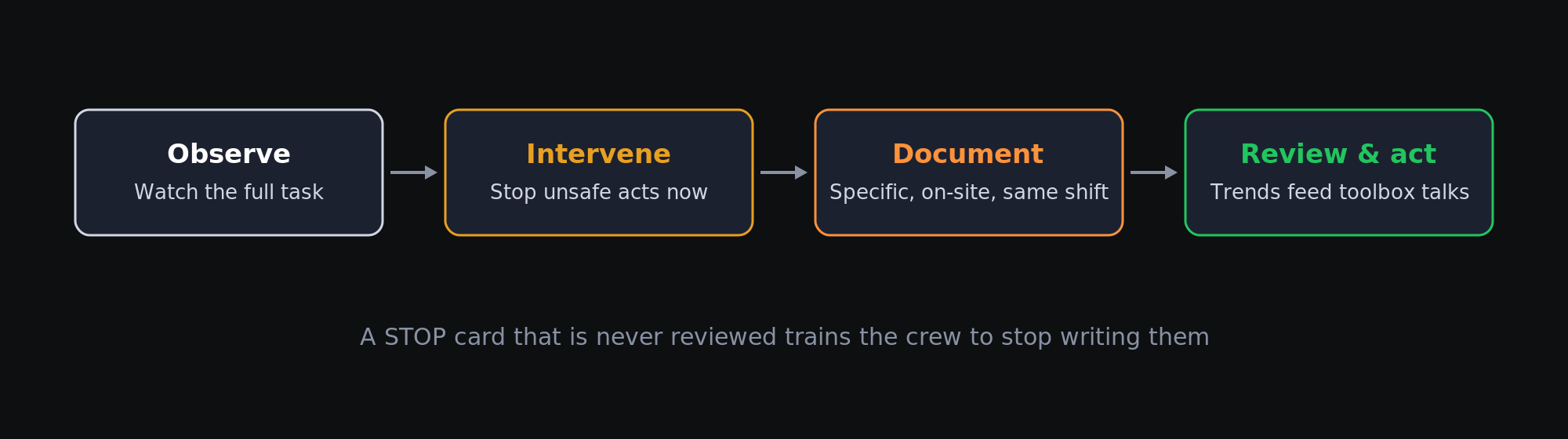
The workflow has four stages, and skipping any of them is what turns a good program into a paperwork exercise.
1. Observation
A crew member watches a task in progress — ideally for at least a minute or two, not a passing glance. They’re looking at PPE use, body positioning, tool condition, communication, and adherence to the permit or procedure.
2. Intervention (if needed)
If the observer sees something dangerous in progress, the card gets filled out after the fact, but the unsafe act gets stopped immediately. STOP was never meant to be a “watch and write it down” exercise when someone’s about to get hurt.
3. Documentation
The observer completes the card on-site or as close to real time as possible, noting the specific behavior, the conditions, and whether it was a safe or at-risk observation.
4. Submission and review
Cards go to the HSE Manager or Safety Officer, who logs them into the tracking system. The turnaround from submission to system entry should be measured in days, not weeks — trend data that sits unentered can’t inform toolbox talks or JSA updates in a useful timeframe.
A STOP card that takes three weeks to reach a database isn’t a safety tool anymore. It’s an archive entry.
How to Fill Out a STOP Card Correctly
Most STOP card templates ask for the same core fields, regardless of the operator:
- Date, time, location on the rig: Be specific. “Rig floor, near the V-door” beats “on location.”
- Task being performed: Name the actual operation — “tripping pipe,” “rigging up top drive,” “BOP function test.”
- Category: PPE, body position, tools/equipment, procedures, housekeeping, or reaction to hazard.
- Safe or at-risk: Mark both when applicable. Most good cards note at least one safe behavior alongside the at-risk one.
- Description of the behavior: This is the field people rush, and it’s the one that determines whether the card is useful.
- Immediate action taken: Did you stop the task? Correct verbally? Note it for later?
- Root cause (if identified): Training gap, time pressure, fatigue, or equipment issue?
Fill the card out where you observed the behavior, not from memory an hour later at the doghouse. Details fade fast, and vague cards are the single biggest reason STOP programs lose credibility over time.
What to Observe: Behaviors, Conditions, and At-Risk Acts
Effective observation isn’t about watching everything at once. Behavioral safety practice generally recommends defining somewhere between 10 and 15 critical behaviors per role or task type, so observers know exactly what they’re checking for instead of trying to catch everything and missing the pattern.
On the rig floor, the categories that generate the most useful STOP data include:
- PPE compliance: hard hats, FR coveralls, task-rated gloves, hearing protection near rotating equipment — the full standards are in the rig floor PPE guide.
- Dropped object prevention: tethering, secondary retention on tools used at height, housekeeping on the derrick.
- LOTO and stored energy: lockout tags applied correctly before maintenance, zero-energy verification before opening equipment.
- Well control discipline: flow checks, kick indicators reported, adherence to shut-in and kill procedures during simulated or real events.
- H₂S protocol: wearing personal monitors in sour service areas, per the H₂S safety guide.
- BOP function checks: whether the testing intervals covered on the blowout preventer page are actually being followed, not just signed off.
Good vs Poor STOP Card Observations
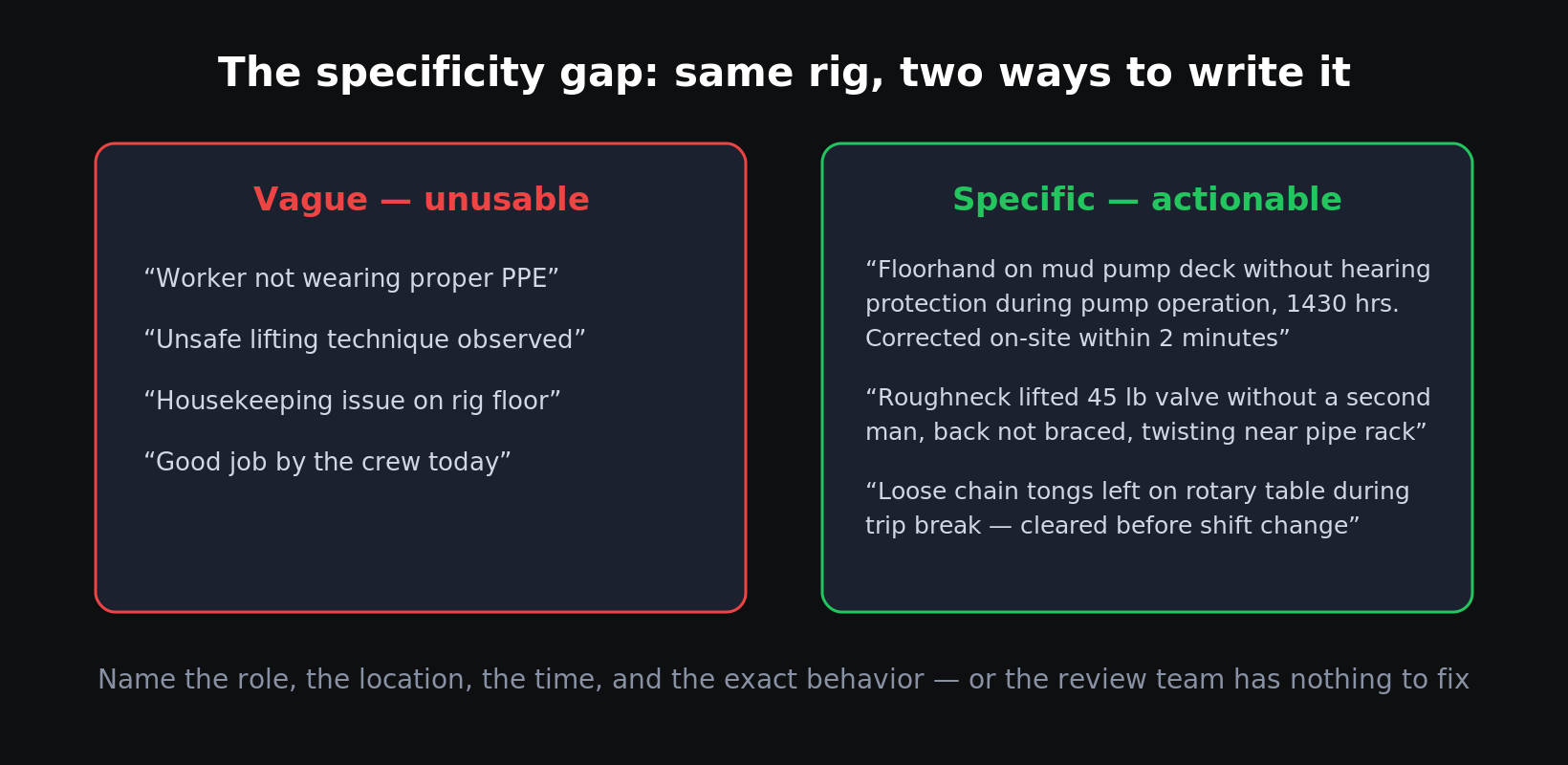
The gap between a useful STOP card and a useless one usually comes down to specificity, not effort.
| Poor observation | Good observation |
|---|---|
| “Worker not wearing proper PPE.” | “Floorhand on mud pump deck without hearing protection during pump operation, 1430 hrs. Corrected on-site, hearing protection donned within 2 minutes.” |
| “Unsafe lifting technique observed.” | “Roughneck lifted 45 lb valve manually without requesting a second man, back not braced, twisting motion during lift near the pipe rack.” |
| “Good job by the crew today.” | “Derrickman conducted full pre-tour inspection of stabbing board and fall arrest anchor points before climbing, verbally confirmed with driller before ascending.” |
| “Housekeeping issue on rig floor.” | “Loose chain tongs and unsecured hand tools left on the rotary table during a break in tripping operations — tripping hazard for next crew, corrected before shift change.” |
Notice that every good example names the role, the location, the time, and the specific behavior. None of them lean on vague adjectives like “unsafe” or “careless” without backing them up with what actually happened.
How STOP Cards Are Reviewed and Tracked
A card that never gets reviewed is a card that trains people to stop writing them. The review process needs structure, ownership, and a visible feedback loop back to the crew.
Weekly trend review. HSE staff sort cards by category, task type, and shift to spot patterns. If PPE non-compliance keeps showing up on night tour specifically, that’s a fatigue or supervision issue, not a random string of bad luck.
Monthly leadership review. Toolpushers, OIMs, and company representatives review aggregate data — not individual cards by name — to keep the focus on systemic issues rather than singling out workers.
Feedback to the crew. Trends get folded into toolbox talks and pre-tour meetings. If nobody on the floor ever hears what came out of the cards they submitted, participation drops fast.
Did you know? Some contractors run a structured coaching layer on top of the card system — sometimes called STOP for Supervision — where designated supervisors are trained to lead intervention conversations rather than just collect cards. The industry learned that a card alone doesn’t change behavior; a conversation does.
Building a Near-Miss Reporting Culture Without Blame
Near-miss reporting is the harder half of any STOP program, because it requires someone to admit they almost got hurt, or that they almost hurt someone else.
Programs that punish the reporter — even informally, through reputation or assignment changes — kill near-miss reporting within a few months. Crews learn fast which behaviors get rewarded and which get buried.
What actually works:
- Separate STOP data from disciplinary records. A card should never be the sole basis for a write-up.
- Recognize high-volume, high-quality reporters publicly. The crew member who files the most detailed cards is doing more for the program than the one who files zero.
- Close the loop fast. If a near-miss gets reported and nothing visibly changes within a reasonable window, people stop bothering.
- Make the form accessible in the field, not locked in an office trailer three hundred feet from where the observation happened.
How STOP Cards Connect to Equipment, Drilling, and Training
A STOP card doesn’t exist in isolation. The data it generates should feed directly into how a rig manages equipment, procedures, and crew development.
If cards keep flagging poor housekeeping around the pipe rack during trips, that’s a signal for the drilling operations team to revisit trip sequencing or staffing during that phase. If observations repeatedly note crews skipping steps on drill string handling, that’s a training gap, not a one-off mistake.
STOP data also intersects with maintenance. Repeated at-risk observations around a specific piece of gear — whether tied to rig-type-specific hazards or a wear pattern on the equipment itself — often points to something that needs engineering attention, not just a verbal correction.
For crew development, some operators fold STOP participation into progression discussions: consistent, high-quality observation reporting is a behavioral marker alongside the technical benchmarks covered in the careers section.
Not every card is about behavior in the strict sense, either. An observer who notices displayed mud weight values that don’t match what the hydrostatic pressure calculator would predict for that depth has a legitimate STOP observation on their hands. And anyone writing cards on hot work should know the standards covered on the rig welding page first, because flagging the wrong root cause wastes the review team’s time.
Conclusion
A working STOP program comes down to three things done consistently: specific observation, fast review, and a culture where reporting doesn’t get punished. Cards that name the exact behavior, get logged within days instead of weeks, and actually change a toolbox talk or a procedure are the ones that prevent incidents.
Cards that sit in a binder unread are just paperwork with a safety label on it. If your rig’s STOP program isn’t producing visible changes to procedures or training within a month of a trend showing up, the system isn’t broken — the review step is.
Frequently Asked Questions
What is a STOP card in the oil and gas industry?
A STOP card is a short observation form used in the Safety Training Observation Program, where crew members document safe and at-risk behaviors they witness on the rig floor. It’s a proactive tool filled out before an incident happens, not an incident report filed after one.
How often should STOP cards be submitted on a rig?
Most operators expect crew members to submit multiple STOP cards per week, with observations logged into the tracking system within days of submission. Higher-frequency, higher-quality reporting is more valuable than hitting a fixed quota with vague cards.
What’s the difference between a STOP card and a near-miss report?
A STOP card documents observed behaviors — safe or at-risk — during routine work, while a near-miss report specifically documents an event that almost caused injury or damage. Many STOP programs include a near-miss field, but the two aren’t identical tools.
Who reviews STOP cards after they’re submitted?
Safety Officers or HSE Managers typically log and review submitted cards first, sorting them by category and trend, before aggregate data goes to toolpushers and rig leadership during monthly safety meetings. Individual cards are generally reviewed without naming the observer publicly.
What makes a STOP card observation “good” versus “poor”?
A good STOP card names the specific role, location, time, and behavior observed — a specific PPE gap or lifting technique issue — rather than using vague terms like “unsafe” or “careless.” A poor observation is generic and unactionable, giving the review team nothing concrete to correct or train against.
Do STOP cards actually reduce incidents on drilling rigs?
When implemented with fast review cycles, specific documentation, and a no-blame reporting culture, behavior-based observation programs have been credited with measurable reductions in recordable incidents across multiple operators. The system only works when cards lead to visible corrective action, not when they’re filed and forgotten.