Steady pull is the obvious response to stuck pipe and frequently the useless one. A drilling jar exists because breaking a bond depends on peak force, and a rig’s ability to apply sustained force is capped long before the sticking force is reached.
The trick is that a jar does not generate energy. It stores what the rig gives it and gives it back all at once.
Key Takeaways
| Question | Answer |
|---|---|
| What does a jar do? | Converts a smooth pull into a short, very high peak force at the stuck point. |
| Where does the energy come from? | The drill pipe above the jar, stretched like a spring by overpull. |
| What holds it back? | A detent that releases at a set load, letting the hammer accelerate into the anvil. |
| Which direction? | Up jars fire upward, down jars fire downward. The choice depends on which way the string is free. |
| What is the cost? | Fatigue. Jar impacts pass through the string, loading tool joints repeatedly. |
| What comes first? | Diagnosis — see stuck pipe and fishing operations. |
Why Steady Pull Runs Out
Overpull is bounded by things that have nothing to do with the stuck point: the hook load rating, the derrick, and the tensile capacity of the weakest joint in the string — which for used pipe is set by its inspected class, not the grade stencilled on it.
Within those bounds the force rises smoothly and then plateaus. If the plateau sits below the sticking force, the string does not move, and holding tension for longer changes nothing. On differentially stuck pipe it can actively hurt, because pulling loads the string harder against the wall and can increase the contact area the pressure acts on.
An impact is a different quantity. The same stored energy released over a few milliseconds produces a peak force far above the steady pull that stored it, which is the whole point of the tool.
Cocking and Firing
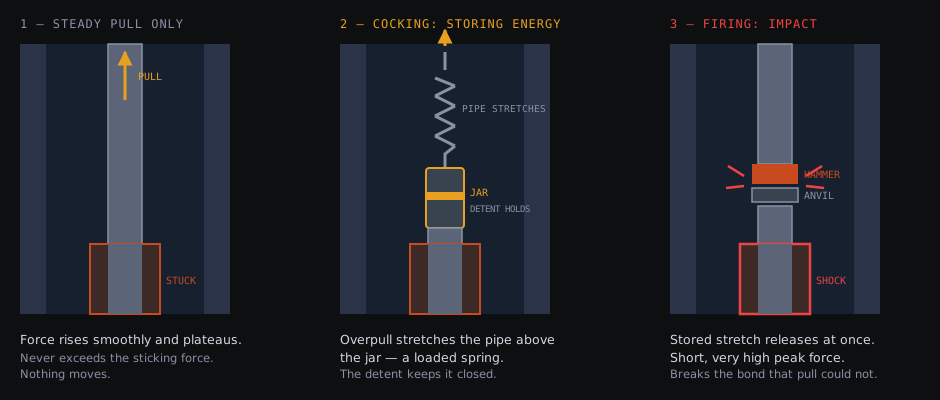
Cocking. The driller pulls overpull above the string’s own weight. The jar stays closed because a detent — mechanical, hydraulic or a combination — holds it. Meanwhile the pipe above the jar stretches. Thousands of feet of steel under tension is a long spring, and it is storing real energy.
Firing. At a set load, or after a hydraulic metering section has bled through, the detent releases. The stretched pipe contracts and drives a hammer section up into an anvil. The impact is transmitted down the drill string to the stuck point. See the hydraulic jar equipment page for an interactive 3D model of the splined mandrel and hammer/anvil section this cycle actually runs through.
Resetting. The jar is set back down to close it, and the cycle repeats. Jarring is normally a repeated sequence over a period, not a single attempt — repeated blows work a bond loose in a way one does not.
Hydraulic jars introduce a delay between reaching the load and firing, so the driller can pull to a chosen overpull and wait for the tool. That delay is a feature: it lets the load be set deliberately rather than snatched.
Up Jars, Down Jars, and Direction
Jars fire in one direction, so the choice is a diagnostic decision rather than a preference.
Up jars are cocked with tension and fire upward. This is the common case, because most sticking is discovered when the string will not come out.
Down jars are cocked by setting weight down and fire downward. They matter when the obstruction is above the stuck point — the classic case being a keyseat entered from below, where driving the string further up jams the tool joint harder into the slot and down is the way out.
Many strings run both, so the direction can be chosen at the time. This is exactly why establishing which way the string is still free comes before firing anything: a jar fired the wrong way is not neutral, it is force applied in the direction that makes the situation worse.
Accelerators
An accelerator is a compressible section — spring or gas — run above the jar.
Its job is to provide a local, responsive energy store. In a deep or high-angle well, the stretch is distributed over thousands of feet of pipe, and friction along a deviated hole absorbs energy before it reaches the tool. An accelerator sits close to the jar and can release quickly, so more of the stored energy arrives as impact rather than being lost to drag along the string.
The deeper and more deviated the well, the more the accelerator earns its place — which is one of the ways well profile decided months earlier shapes what can be recovered when something goes wrong. Profile and its consequences are covered on the directional drilling page.
The Cost: Fatigue
Jarring is not free, and treating it as free is how a recoverable situation turns into a fishing job.
Every impact passes through the whole string. Tool joints and connections take repeated shock loading, and repeated shock is a fatigue mechanism rather than an overload one — the string can be comfortably inside its tensile rating and still fail after enough cycles. It is the same failure mode a dogleg drives, arriving by a different route.
That is why jarring is run to designed limits: a maximum overpull, and an understanding of how many cycles are acceptable. Those limits come from the weakest component in the string, and for used pipe that is its inspection class.
There is a second-order risk too. If jarring parts the string, the resulting top of fish is a torn end rather than a clean connection, which makes the subsequent fishing job materially harder. A deliberate back-off leaves a proper thread to latch onto. Jarring until something breaks does not.
Diagnosis Comes First
Jarring is a response, not a reflex. Two things should be established before the first blow.
Which mechanism. Circulation state separates differential from mechanical sticking, and the correct response differs. On differentially stuck pipe the force is pressure times area, and the real solution is reducing hydrostatic pressure — jarring may help, but jarring while leaving a large overbalance in place is fighting the tool’s own working conditions.
Which direction is free. As above, this decides which jar to fire.
Both take minutes. Both are worth it, because the alternative is applying force in a direction and manner chosen by instinct at the point of highest stress.
Conclusion
A jar is a mechanism for turning what the rig can do — pull steadily — into what the situation needs, which is a short violent blow. It works because peak force breaks bonds and sustained force often cannot.
What it is not is a substitute for diagnosis, or a free action. Every cycle spends fatigue life on a string that has to come out of the hole afterwards, and the direction it fires should be chosen from evidence rather than hope.
Where jarring sits in the wider sequence — free point, back-off, fishing tools, and when a sidetrack becomes the cheaper answer — is covered in stuck pipe and fishing operations.
Frequently Asked Questions
How does a drilling jar work?
A jar is held closed by a detent while overpull stretches the drill pipe above it, storing energy in the pipe like a spring. When the detent releases, that stored stretch snaps a hammer section up into an anvil, delivering a short high force impact at the stuck point instead of a steady pull.
Why does an impact free stuck pipe when pulling does not?
Peak force matters more than sustained force for breaking a bond. Steady overpull is limited by the hook load the derrick and string can safely carry, and it plateaus below the sticking force. A jar concentrates stored energy into a few milliseconds, producing a peak far higher than the pull that cocked it.
What is the difference between an up jar and a down jar?
An up jar is cocked by pulling tension and fires upward, used when the string is stuck going up, which is the most common case. A down jar is cocked by setting weight down and fires downward, used when the obstruction is above the stuck point, such as after a keyseat has been entered from below.
What does a jar accelerator do?
An accelerator is a compressible spring or gas section run above the jar. It provides a local source of stored energy so the hammer can accelerate freely, rather than depending on the stretch of a very long pipe string. It matters most in deep or high angle wells where friction absorbs energy before it reaches the jar.
Can jarring damage the drill string?
Yes. Jar impact loads pass through the string and repeated jarring is a fatigue mechanism at tool joints and connections, in the same way a dogleg is. Jarring is run to a designed load limit set by the weakest component, which for used pipe is its inspected class rather than its stencilled grade.
Should you jar immediately when pipe gets stuck?
Not before establishing which sticking mechanism is present. Circulation state distinguishes differential from mechanical sticking, and the correct response differs. Jarring is also directional, so knowing which way the string is free matters before firing a tool that will drive it further the wrong way.